BOSS TWEED: The Corrupt Pol who Conceived the Soul of Modern New York by Ackerman Kenneth D
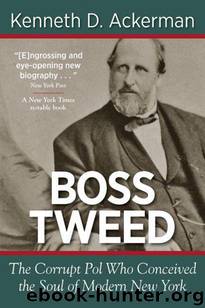
Author:Ackerman, Kenneth D. [Ackerman, Kenneth D.]
Language: eng
Format: epub
Tags: History
Publisher: Viral History Press LLC
Published: 2011-12-22T08:00:00+00:00
-------------------------
Tweed spent most of his time after the coup d’etat hiding from newspaper reporters in his office at the Public Works Department on Broadway. Here, he greeted the usual stream of politicos hawking gossip and favors but closed the door on newsmen. “I have nothing to say. I cannot say anything,” he told a New-York Times writer who managed to grab him in the lobby for a minute. “You can understand my position. I don’t want to complicate my friends.”28
Behind this stoic front, though, Tweed must have bit back on a stew of emotions that would choke any weaker person: rage, fear, disappointment. That summer and fall, he’d seen a parade of former friends jump ship and betray him: Jimmy O’Brien whom he’d made sheriff, George Barnard whom he’d made judge, and now Slippery Dick Connolly. With Connolly, at least he’d had fair warning. Tweed knew Connolly’s history of treachery: In 1862, when Tweed was still clawing his way up at Tammany and feuding with a rival Wigwam faction, he’d seen Connolly switch sides three times before coming back to ask favors.29 Now, Tweed must have marveled at Connolly’s gall, trying to cut a deal with prosecutors to save his own fortune while avoiding jail—leaving the Boss holding the bag.
His back to the wall, Tweed spoiled for a fight. His seat in the Albany legislature as state senator came up for re-election that year and, scandal aside, he damned well planned to keep it. The time had come to put his foot down, better late than never. Through his lawyers, he presented his own sworn statement in Judge Barnard’s courtroom that week flatly denying all the charges against him—fraud, conspiracy, misconduct, neglect of duty, or anything else. It was all “untrue,”30 a “general denial,” he insisted. “I don’t intend at my time of life to go fighting windmills.”31 The few reporters who did reach him that week found him unapologetic. “As to the cry about thieving—why, that’s politics,” he told one. “I tell you, I shall come out of this fight as clean and square as any man in the community. Only give me the chance to meet the charges openly and aboveboard. I am never so happy as when I am in a fight.”FOOTNOTE32
Tweed still had plenty of friends from his lifetime of favors and spoils. “All my professional and personal ability or influence is at your service at all times and upon all occasions,” James C. Spencer of the State Supreme Court wrote him.33 Leaders of the William M. Tweed Association of the Second Ward (today’s lower East Side around Fulton Street) cheered him at a rally on Park Row that week and blasted his opponents as “a few political soreheads and vile ingrates.”34 Other friends formed a new Central Tweed Organization to back his re-election to the state senate.35 Even Jimmy O’Brien, who’d brought disaster on Tweed’s head by disclosing the Secret Accounts to the New-York Times, still spoke fondly. “Mr. Tweed is the most honorable man of the lot,” he said when asked about the jousting at City Hall: “Tweed is plucky….
Download
This site does not store any files on its server. We only index and link to content provided by other sites. Please contact the content providers to delete copyright contents if any and email us, we'll remove relevant links or contents immediately.
Waking Up in Heaven: A True Story of Brokenness, Heaven, and Life Again by McVea Crystal & Tresniowski Alex(37872)
Empire of the Sikhs by Patwant Singh(23135)
We're Going to Need More Wine by Gabrielle Union(19108)
Hans Sturm: A Soldier's Odyssey on the Eastern Front by Gordon Williamson(18649)
Leonardo da Vinci by Walter Isaacson(13411)
The Radium Girls by Kate Moore(12093)
Tools of Titans by Timothy Ferriss(8492)
Educated by Tara Westover(8107)
How to Be a Bawse: A Guide to Conquering Life by Lilly Singh(7545)
Permanent Record by Edward Snowden(5892)
The Last Black Unicorn by Tiffany Haddish(5683)
The Rise and Fall of Senator Joe McCarthy by James Cross Giblin(5317)
Promise Me, Dad by Joe Biden(5189)
The Wind in My Hair by Masih Alinejad(5138)
A Higher Loyalty: Truth, Lies, and Leadership by James Comey(5017)
The Crown by Robert Lacey(4862)
The Iron Duke by The Iron Duke(4405)
Joan of Arc by Mary Gordon(4156)
Stalin by Stephen Kotkin(4004)
